
Exercise for violinists: It’s always the first thing to go
What my warm-up couldn’t fix on its own
Warming up a few weeks ago, I noticed I just didn’t have any energy. Everything felt sluggish, like I just didn’t have enough juice. It got me thinking about something most musicians don’t talk about enough: exercise for violinists isn’t optional – it shows up in your playing whether you planned for it or not.
And it occurred to me that I never felt that way on the day of or the day after getting some exercise. Particularly, lifting weights generally has an immediate impact on how well I feel physically as I’m playing the violin.
I also realized it had been a couple of weeks since I’d gone running. Akiko and I usually go a couple of times a week, but things got busy. And when things get busy, exercise is always the first thing to go.
So I went and did some weights, and when I came back to the violin I felt…springier. It was easier to support the instrument. Everything felt more nimble and more alive, the opposite of sleepy. The larger muscle groups were doing what they were supposed to do, and the smaller ones weren’t working overtime to compensate.
I’ll also say: the times I’ve had nagging little injuries from playing have tended to be the same times I haven’t been doing weights. I don’t think that’s a coincidence.
I never skip my warm-up. Not before a rehearsal, not before a performance, not on a day when I only have twenty minutes to play. The warm-up isn’t about building technique – it’s about getting ready: warming up my ear, my sound, my body. What it looks like changes depending on what I need that day.
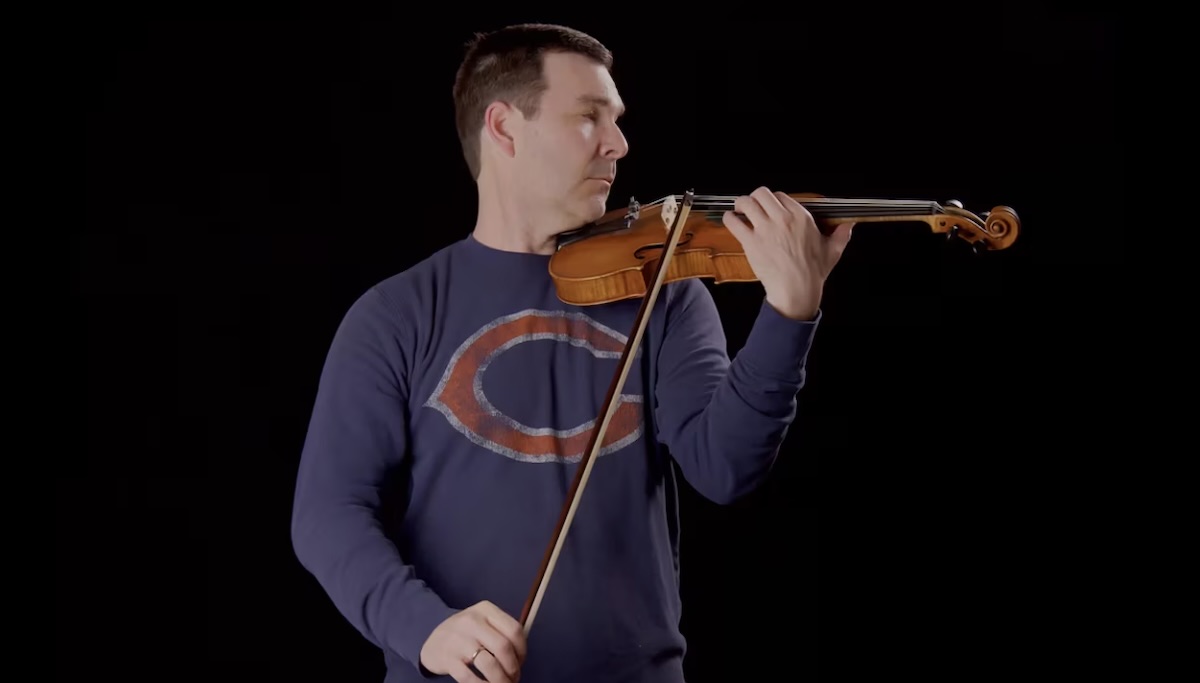
You can watch one here – notice the moments where I put the violin down and stretch. That’s not wasted time.
What I’m realizing is that the weights and the running are really just an earlier layer of the same thing. Physical preparation doesn’t start when I pick up the violin. The more consistently I’m taking care of my body off the stand, the less work my warm-up has to do, and the more quickly I’m actually ready to play.
This is not a small thing when you’re in your late forties and you’ve been playing seriously since childhood. The position we play in is not one the human body was designed for. Longevity as a player doesn’t happen by accident.
I should say: I’m not a wake-up-at-5 person, and I’m probably not ever going to be. I don’t have a strict routine. The schedule makes that hard, and I’m not sure it would suit me anyway.
Something is better than nothing – a few dumbbells at home, a run when Akiko and I are both in town. Fifteen or twenty minutes, a couple of times a week. It doesn’t have to be heroic to make a difference.
I believe this just as much about the violin. To the extent that what you’re playing is real music – not just noodling, not just scales and exercises, but actual pieces worth spending time with – that’s even better. That’s the whole idea behind Daily Virtuoso: what you do on any given day matters less than staying close to the music over the course of a month, working on different sections, coming back to it, keeping it warm. The everyday routine doesn’t have to be the same, but having a piece you’re genuinely working toward changes everything.
The exercise thing is the same idea applied to the body. It’s not about the curls or the miles. It’s about showing up to the instrument with something in reserve.
Comment section
5 thoughts on “Exercise for violinists: It’s always the first thing to go”
Leave a Reply
Scales: The Road
to Repertoire
Even if you’ve never played a scale before, violinist Nathan Cole of the Los Angeles Philharmonic will guide you through scale routines that meet you where you are, and build progressively alongside your playing.

Thank you so much for your inspiration Nathan. I’m an adult learner and appreciate your openness and generosity in sharing your beautiful gift, skills and knowledge and love of music! I now know how I will take my practice to the next level with a sound warm up and good body / muscle awareness.
Speaking as both a violinist and and a surgeon, the physical demands of playing a musical instrument-especially one as awkward as the violin-must be respected as much as if one were, say, a tennis player. In this respect, sports trainers and sports physiologists have been ahead of the music world for a long time. It is a mistake to teach the instrument, or conversly to learn, according to a certain “school.” Technique must be based on sound physiologic/ergonometric principles. Violinists who had long careers and maintained their technique to an advanced age-I am thinking of Milstein and Ricci-did this instinctively. The Performing Arts Medicine Association is a useful organization for interested parties.
Thank you so much for sharing this warm-up video.